The Life Line: A Line of Energy and Pace, Not of Years
The line you see curving round the thumb on your palm is called the life line. It is perhaps the best-known line in palmistry, and it is also the one most misunderstood.
Many people believe that a long life line means more years lived and a short one means fewer. That is not true. The length of the life line tells nothing at all about how many years anyone’s life will run. Tradition sees energy, zest and the pace at which you live in this line.
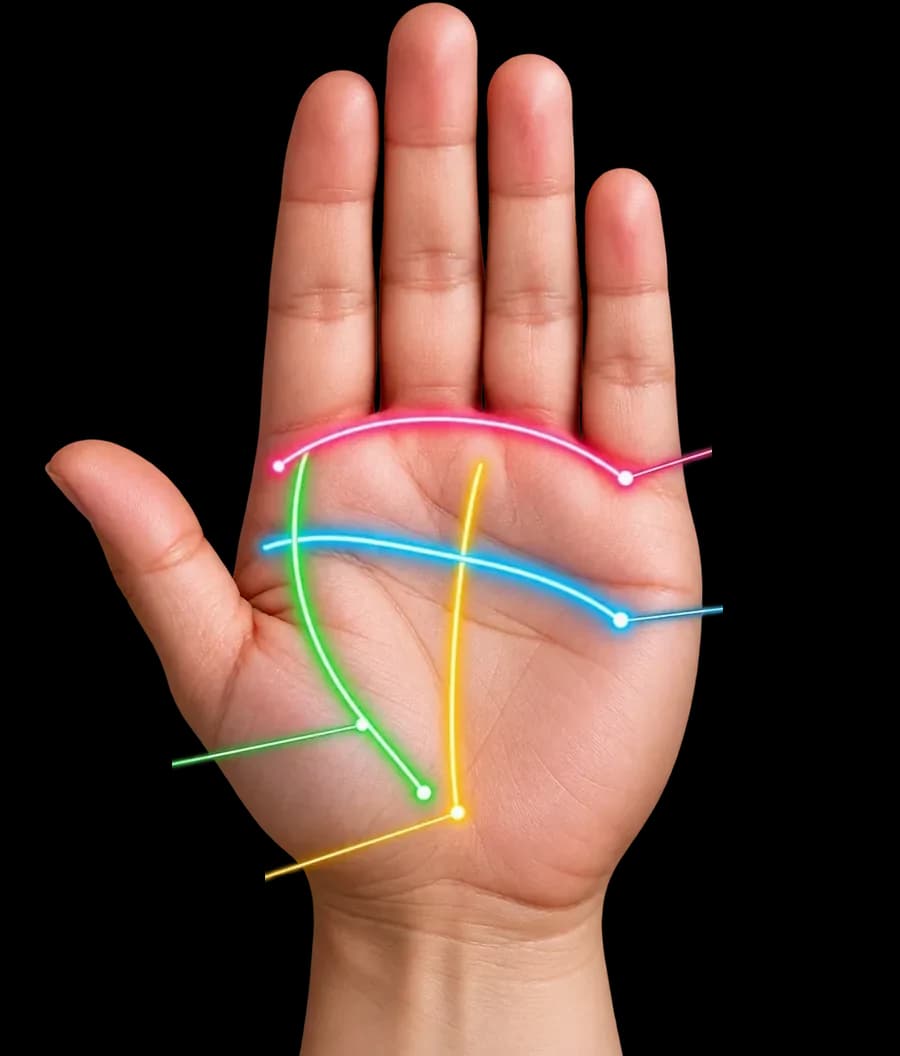
Where the life line is
This line begins between the thumb and the index finger, often together with the head line, and then sweeps round the raised pad below the thumb towards the wrist. In palmistry, this pad below the thumb is called the Mount of Venus.
The line looks different on every palm: deep and long on one, faint on another, leaving a small gap partway on a third. These are all common forms.
A wide curve or one close to the thumb
The first thing tradition looks at is how wide a curve the life line makes across the palm.
- A wide curve, reaching towards the centre of the palm: This is linked to plenty of zest, enjoying the company of others and enthusiasm for new things.
- A curve that hugs the thumb: This is linked to a calm, thoughtful nature that likes familiar surroundings and its own pace.
Neither is better than the other. Some people like to spend their energy freely out in the world; others prefer to pace it carefully, in their own way.
A deep, faint or broken line
Tradition links a deep, clear life line to steady energy and dedication. A faint line is often linked to a nature that adapts to circumstances. A faint line is no shortcoming; often it is simply the effect of the skin or the light in the photo.
If there is a break or a gap in the life line, tradition links it to a change in daily life, work or where you live, such as a new phase or a fresh start. There is nothing in it to be afraid of.
A second line alongside, and branches
On some palms a thin line runs alongside the life line, just inside it. It is called the line of Mars or the sister line, and tradition links it to inner courage and a strength that sees you through hard times.
Small branches rising from the life line towards the fingers are linked to hard work and the wish to move ahead. Tradition links a branch heading down towards the Mount of the Moon to a love of travel and of seeing new places.
What the life line does not tell
This is worth repeating, because it is what worries people most:
- The life line does not tell how many years anyone’s life will run.
- It says nothing about your body or wellbeing. For anything of that kind, see a doctor.
- A broken or short line is not a sign of any hardship or trouble.
- This line does not tell the timing of any event.
Compare both hands
Tradition holds that the hand you write with shows what you have built through your own experience, and the other hand shows what was in your nature from the start. If the curve of the life line differs between your two hands, it is read as a sign that your energy and the pace of your life have changed over time.
Do not read the life line on its own. How full the Mount of Venus is, where the head line begins, which element your hand belongs to: only with all of these together does the full picture form.
In the end
Look at your life line with curiosity, not fear. Tradition reads in it the way your energy flows: whether you like to live life at a fast pace or a gentle one, openly or with care. It is an interesting way to reflect on yourself, and nothing more than that.
Read your own palm reading
Hold your palm up to your phone’s camera. From the lines, mounts and hand shape visible in your photo, the AI writes your reading according to tradition, in under a minute.
Check your palm for ₹1₹1 today, then ₹499/month after 3 days. Cancel anytime.
Read next
The Head Line: The Palm’s Line of How You Think
Where the head line runs across your palm, and how tradition links its length, slope and starting point to the way you think and make decisions.
The Fate Line: A Line of Work, Responsibility and Direction
Not every palm has a fate line, and that is no shortcoming. See how tradition links this line to work, responsibility and your sense of direction.
The Mounts of the Palm: What Each Means, from Venus to the Moon
The raised pads below the fingers and along the edges of the palm are called mounts. See where all seven sit and which qualities tradition links them to.
For entertainment purposes. Not medical, legal or financial advice.