The Head Line: The Palm’s Line of How You Think
Just below the heart line, the line that runs across the middle of the palm is called the head line. Some people also call it the line of wisdom or the line of the mind. According to tradition, this line is linked to the way you think: how you make sense of things and reach decisions, and whether your mind leans more towards practical matters or towards imagination.
Let us be clear about one thing first: the head line does not tell how clever anyone is. Tradition sees a style of thinking in it, not a measure of intelligence.
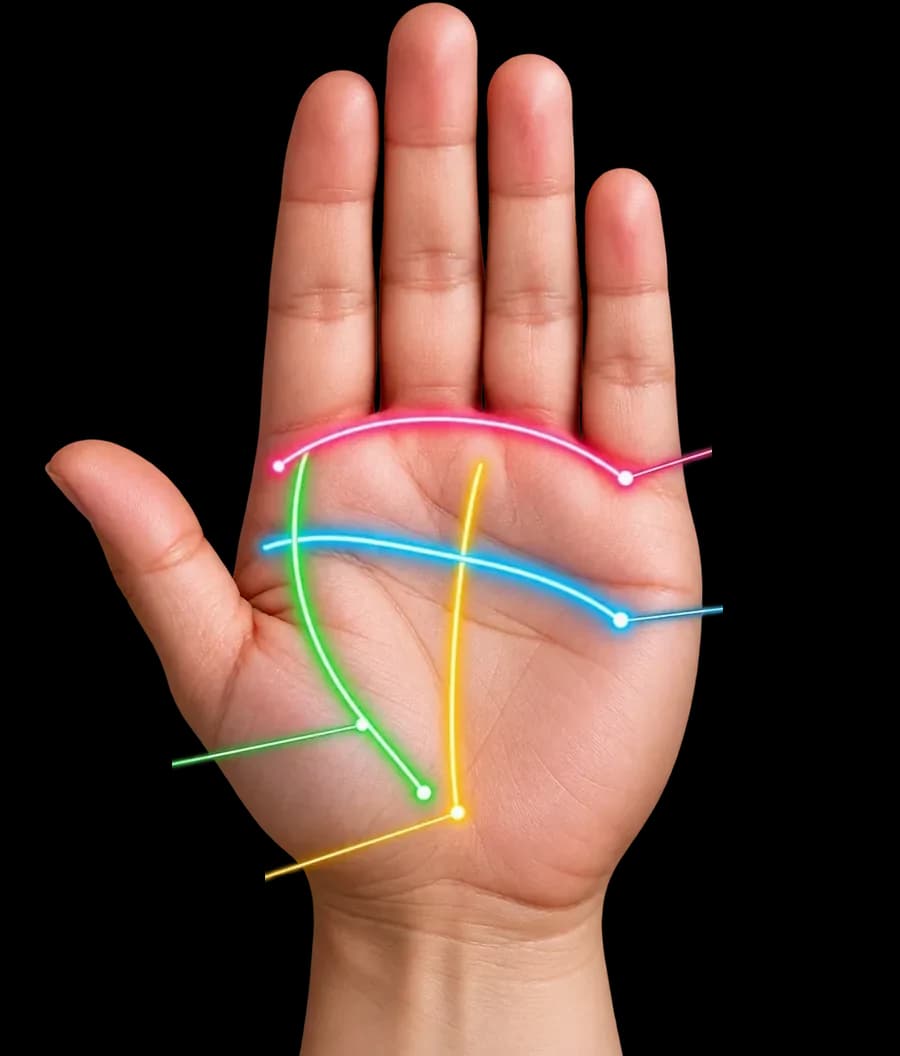
Where to find the head line
Start looking at the edge of the palm between the thumb and the index finger. A line sets out from there, crosses the middle of the palm and heads towards the side with the little finger. That is the head line. On many palms its start is joined to the life line, so the two seem to begin from the same point.
Above it lies the heart line, and below it the life line, curving round the thumb. Once you can pick out all three together, reading a palm becomes much easier.
Straight or sloping down
Tradition looks most closely at the direction this line takes.
- Straight, right across the palm: This is linked to practical, logical thinking. It is said that solid facts and a clear plan put the mind at ease.
- Gently sloping: This is linked to a blend of the practical and the imaginative: keeping your feet on the ground while thinking in fresh ways.
- Sloping steeply towards the Mount of the Moon: The lower outer part of the palm is called the Mount of the Moon. Tradition links a head line that dips towards it to imagination, creativity and a love of stories.
Long or short
A long head line, one that reaches close to the far edge of the palm, is linked in tradition to the habit of looking at a matter from many sides. A short line is linked to going straight to the point and deciding quickly.
Here too, no form ranks higher or lower. Sometimes thinking deeply is what helps, and sometimes deciding swiftly.
The start: joined to the life line or apart
If the head line begins joined to the life line, tradition links this to taking careful steps and valuing the views of the people close to you. If there is a little gap between the two from the very start, it is linked to independent thinking, going your own way and the courage to try new things.
How far the two run together is also noticed. Lines that travel side by side for a short way and then part are very common, and tradition simply reads them as a habit of making your own decisions that formed gradually.
Branches, forks and waves
Many head lines split into two at the end. Some call this the writer’s fork, and tradition links it to being able to see both sides of a matter and to put ideas across in different ways.
A wavy line is linked to having many interests at once and to ideas that keep shifting. If the line looks broken somewhere, tradition takes it as a mark of a change in the direction of your thinking or your interests. Remember, in a photo a break is often just an effect of the light.
Keep in mind while reading
- The head line does not tell the whole story on its own. Look at it together with the heart line: according to tradition, the two together show how your heart and head work in step.
- This line does not tell exam results, jobs, or whether a decision is right or wrong.
- A faint line does not mean less understanding. Often the line simply shows less clearly in the photo.
- Compare the head line on both your hands. Tradition reads a difference as a sign that your way of thinking has changed with experience.
In the end
Read your head line as an interesting question about the way you think: do you find it natural to plan first, or to follow your instincts and set off? Set what tradition says beside your own experience. Keep what feels right, and let go of what does not.
Read your own palm reading
Hold your palm up to your phone’s camera. From the lines, mounts and hand shape visible in your photo, the AI writes your reading according to tradition, in under a minute.
Check your palm for ₹1₹1 today, then ₹499/month after 3 days. Cancel anytime.
Read next
The Heart Line: How Palmistry Reads the Line of Feeling
Where the heart line sits on your palm, and how tradition links its length, curve and ending to the way you feel and relate to others.
The Life Line: A Line of Energy and Pace, Not of Years
The biggest myth about the life line is that it counts your years. Tradition links it to energy, zest and the pace of life. Here is how to read it.
The Four Hand Types: Earth, Air, Fire and Water Hands
The shape of the palm and the length of the fingers sort hands into four elements. See how to recognise your own hand and how tradition reads each type.
For entertainment purposes. Not medical, legal or financial advice.