The Heart Line: How Palmistry Reads the Line of Feeling
The topmost line running across your palm, just below the fingers, is what palmistry calls the heart line. Many people also call it the line of love. According to tradition, it is linked to the way you feel emotions and express them, and to what matters most to you in your relationships.
In this article we look at how to find your heart line, how tradition reads its different forms, and what to keep in mind while reading it. One thing to be clear about from the start: palmistry is an old tradition for understanding temperament, not a way of working out what is to come.
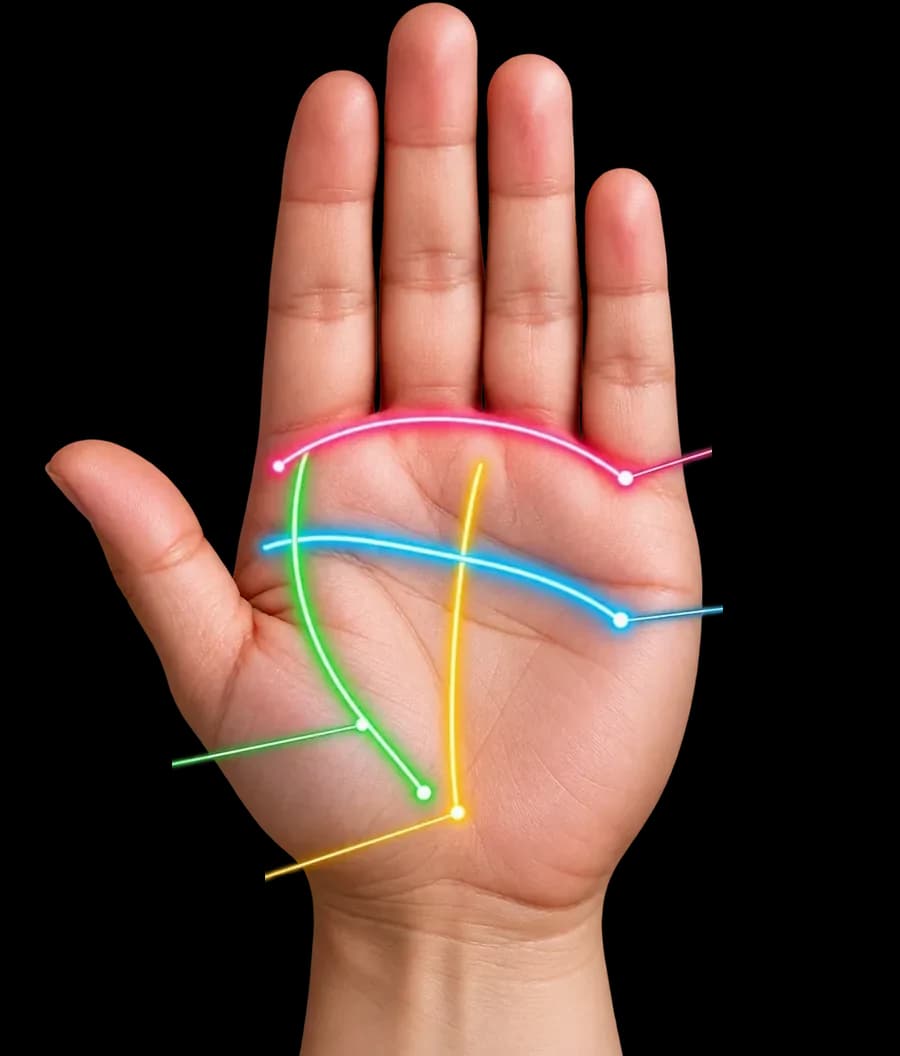
Where the heart line is
Hold your palm in front of you and look just below the fingers. A line begins at the edge of the palm under the little finger and travels towards the index finger or the middle finger. That is the heart line. Below it, running in roughly the same direction, is a second line across the palm: the head line.
On some palms the heart line is deep and clear; on others it is faint. Both are perfectly common. How deep a line looks also depends on the light, the skin and the shape of the hand.
Where the line ends
In tradition, the end of the heart line carries special weight: the point where the line reaches up towards the fingers and stops.
- Below the index finger: Tradition links this to high ideals in relationships, loyalty and an open heart.
- Between the index and middle fingers: This is taken as a sign of a good balance between feeling and good sense.
- Below the middle finger: This is linked to a practical approach to feelings: saying what is in your heart after thinking it over.
- Right across the palm: A long line that crosses the whole palm is linked to deep feelings that flow freely.
Straight or curved
The shape of the heart line is read too. A line that curves gently up towards the fingers is linked in tradition to warmth and to expressing your feelings openly. A straighter line with little curve is linked to a calm, thoughtful nature, where feelings run deep but are not always put into words.
Neither form is better or lesser. They are simply different ways of living with your feelings. Some people find it natural to show love in words; others show it in small, everyday acts.
Branches, breaks and chain-like marks
Many heart lines have small branches coming off them. Branches that rise upwards are linked in tradition to enjoying company, friendship and closeness. If part of the line is made of tiny links that look like a chain, tradition links them to sensitivity and depth of feeling.
If the line looks broken somewhere, there is no need to worry. Tradition often links a break to a change in how you think or feel, such as seeing things in a new way after some experience. Quite often, a break that shows up in a photo is really just the light or a crease in the skin.
The heart line on both hands
Tradition holds that the hand you write with shows what you have built through your own experience, and the other hand shows what was in your nature from the start. So if the heart line looks different on your two hands, that is interesting in itself.
For example, if the line is straight on one hand and curved on the other, tradition reads it as a change over time in the way you express your feelings: perhaps staying quiet once came more easily and now speaking openly does, or the other way round.
Things to keep in mind while reading
- One line never tells the whole story. In palmistry the heart line is read together with the head line, the Mount of Venus below the thumb and the shape of the hand.
- The length or depth of the line does not decide how much love there will be in anyone’s life, or how any relationship will turn out.
- Lines can change a little over time, so do not treat this as something carved in stone.
- Make decisions about relationships with your own judgement and by talking to people you trust, not by looking at your palm.
In the end
Read your heart line as a light-hearted question about your own heart: how do you tend to show what you feel, and what do you treasure most in your relationships? Set what tradition says beside your own experience. Whatever rings true becomes a fresh reason to reflect on yourself.
Read your own palm reading
Hold your palm up to your phone’s camera. From the lines, mounts and hand shape visible in your photo, the AI writes your reading according to tradition, in under a minute.
Check your palm for ₹1₹1 today, then ₹499/month after 3 days. Cancel anytime.
Read next
The Head Line: The Palm’s Line of How You Think
Where the head line runs across your palm, and how tradition links its length, slope and starting point to the way you think and make decisions.
The Marriage Line: How Tradition Reads Close Bonds in It
The short lines below the little finger are called marriage lines. See what tradition reads in them, and why they give no dates or counts.
The Mounts of the Palm: What Each Means, from Venus to the Moon
The raised pads below the fingers and along the edges of the palm are called mounts. See where all seven sit and which qualities tradition links them to.
For entertainment purposes. Not medical, legal or financial advice.